Julian Carax’s illegitimate parentage
The Shadow of the WindJulian Carax’s illegitimate parentage is the concealed fact at the center of his fraught childhood with Antoni Fortuny. Sophie Carax became pregnant by a man whose identity she never disclosed; Fortuny, her husband, was not Julian’s biological father. His insistence on treating the child as a mark of sin rather than an innocent member of the household made the secret consequential not only as a matter of ancestry, but as a lasting wound in Julian’s sense of himself.
Identity and Background
The parentage question first surfaces as neighborhood hearsay. A caretaker recalls that Sophie confided to Vicenteta, a young neighbor who sometimes sheltered her, that the boy was not the hatter’s. When Daniel Sempere asks whether Julian was not Fortuny’s son, the caretaker confirms only what Sophie reportedly told Vicenteta; she cannot identify Julian’s real father. The account introduces the secret through a chain of women’s confidences, not through an official record or a name.
Sophie’s history clarifies the circumstances. She and Antoni Fortuny married after he pursued her, and she became pregnant six months later, telling him that the child was by another man. She refused to reveal the father’s identity, and the available evidence gives no further identification. The distinction is therefore clear but limited: Fortuny was Julian’s legal and household father in the sense that he was married to Sophie, while the biological father remained an unnamed stranger.
Fortuny’s Response
Fortuny interpreted the pregnancy through his own religious logic, deciding that the child must be the devil’s and calling him a child of sin. His response did not resolve Julian’s origins; it imposed a judgment on them. He covered the apartment with crucifixes and confined Sophie to a room, while his suspicion and hostility made the household a place where the child’s birth was treated as an offense.
Sophie nevertheless insisted that Julian was innocent and needed both a home and a father. Her appeal distinguishes the child from the circumstances of his conception, even as Fortuny’s behavior refused that distinction. Fortuny did not cast Sophie and the child out, in part because he feared the effect a public scandal would have on his hat business. That practical decision kept Julian under the same roof as the man who would repeatedly deny him the respect and security associated with fatherhood.
Julian’s Knowledge and Relationship with Fortuny
Years later, Julian told Nuria Monfort that Sophie had had an affair with a stranger before her marriage, and that this unnamed man was his real father. Julian’s account confirms the core of the earlier rumor while preserving the central blank: he did not know, or at least did not tell Nuria, the stranger’s name. He also distinguished biological paternity from the role Fortuny occupied in the home. Although the hatter was his mother’s husband, Julian never regarded him as a father.
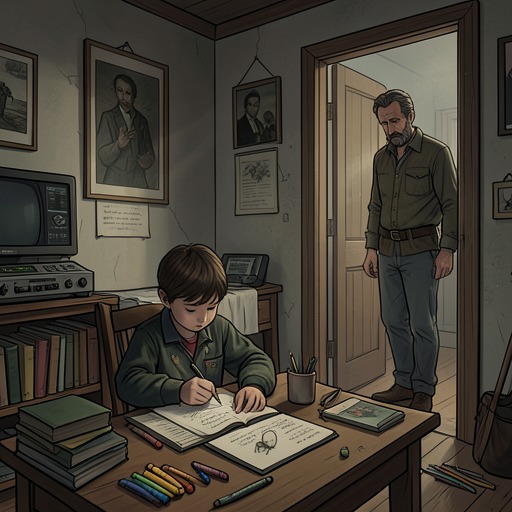
Julian remembered growing up as Fortuny insulted and beat Sophie, then carried the contempt into Julian’s room. Fortuny told him he was the son of sin, had inherited his mother’s supposedly weak character, and was destined to be miserable and fail. These accusations made parentage a weapon: Julian was made to bear responsibility for a relationship and an identity he had not chosen. Nuria judged that the scenes cost Julian all respect for the hatter. Julian spoke of them as though they belonged to a past he had left behind, but, as Nuria observes, the words inflicted on a child remain in memory and may continue to shape him.
The Secret’s Narrative and Emotional Significance
The revelation arrives in stages. The caretaker’s secondhand account raises the question, while Julian’s later disclosure to Nuria supplies his own understanding of the family secret. The two accounts converge on the fact of Sophie’s affair but do not identify the biological father. That omission is important: the story establishes Julian’s origins without offering a name that could settle them, leaving his identity defined partly by what the household refuses or cannot tell him.
The contrast between the biological stranger and Fortuny sharpens the meaning of fatherhood in Julian’s childhood. The unnamed man is his father by descent, yet remains absent from the story; Fortuny is present in the home, yet Julian rejects him as a father because his conduct consists of humiliation and hostility rather than care. The secret thus explains the source of Fortuny’s accusations, but it does not excuse them. Its lasting force lies in the way Julian is taught to understand himself through another man’s condemnation, even after he appears to have put that past behind him.